
Offensive trans dating language: what the evidence tells us
Butterfly Dating · Research review · 15 October 2026
A dating profile is an introduction to a person. The words around it should reflect that.
Offensive labels can appear in dating searches, app descriptions and private messages. Butterfly’s response is to challenge that language while giving people a practical way to learn. This article brings together published research, terminology guidance and our own product history. It is not a new survey or a test of Butterfly’s effectiveness.
Offensive words are quoted below to explain and challenge their use.
Different sources answer different questions
Community guidance
GLAAD identifies “tranny”, “she-male”, “he/she” and “shim” as defamatory language. Its guidance centres people’s chosen identities rather than imposed labels. This is terminology guidance, not a measurement of how often abuse occurs.
Read GLAAD’s glossaryDating-app interviews
Griffiths and Armstrong interviewed 15 trans and non-binary people. Their themes included identity expression, fetishisation and safety, alongside the value of apps for connection. Published online in 2023 and in a 2024 journal issue, the study offers depth, not a population-wide rate.
Read the study abstractBroader dating research
Pew’s 2022 US survey, published in 2023, found that 24% of adults who had used online dating had been called an offensive name there. This is a finding about online daters overall, not a statistic specifically about trans people or Butterfly.
Read Pew’s researchWhy a search term should not become someone’s identity
Someone searching “shemale dating” or “tranny dating” may not understand the language they have encountered. A respectful service can meet that person with an explanation rather than repeat the term as a category of members.
Butterfly’s position is that search visibility should lead people towards respectful interaction. It should not require trans members to see themselves marketed through words they find degrading. Our terminology guide explains the words and the messaging feature in more detail.
Not all unfamiliar terms have the same meaning. “TS” is an abbreviation, and some people use transsexual as a self-description. Others do not. Cultural identity terms and reclaimed words also need context. Following someone’s chosen language is more useful than guessing from a label. See the TS dating guide.
What Butterfly changed after listening
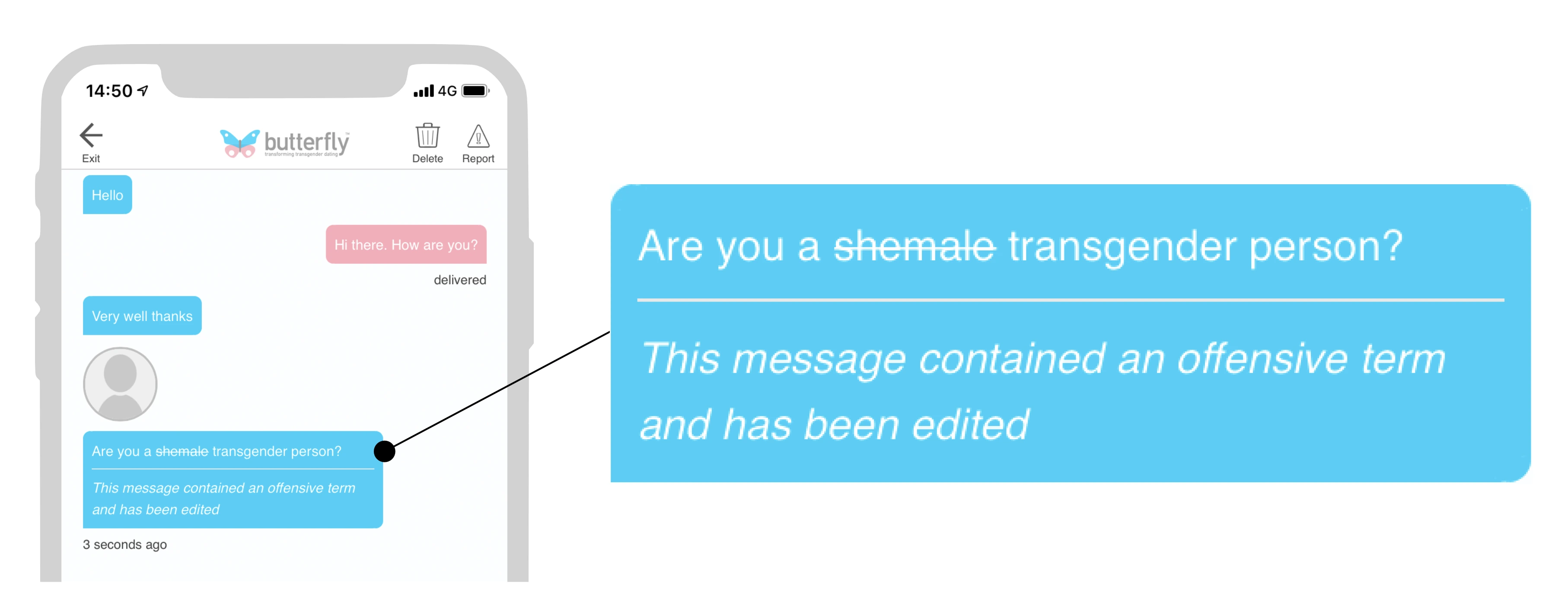
In our original community feedback, members identified several terms they found offensive. Some cisgender members said they had not realised the words were offensive and welcomed being told. Butterfly developed a tool that flags recognised terms in private messaging, strikes them out, adds replacement wording and marks the message as edited.
The correction stays visible, so both people know the text was changed. The aim is to make learning part of a conversation without requiring the recipient to explain everything themselves.
David Minns’s open letter to Apple and Google extended the campaign to dating-app marketing. The letter records what Butterfly asked for; it is not evidence of an app-store policy change.
Words are one part of behaviour
A person can use polite vocabulary and still ignore boundaries. Conversely, an unfamiliar person may accept a correction and make a sincere effort to change. Look at whether someone listens, accepts a no and shows interest beyond your trans identity.
Our practical recommendation is to make corrections specific and brief when you want to: “Please use trans woman when talking about me.” You are also free to end contact instead. These are suggested approaches, not research-tested scripts.
If the problem is repeated pressure or objectification, see our research-informed guide to chasers. Block and report tools address behaviour that a word filter alone cannot resolve.
What the evidence does not show
These sources do not establish that every trans person uses the same terms, that a particular dating platform is the safest, or that Butterfly’s filter prevents all harassment. The small interview study and the wider US survey also measure different things and should not be combined into a single “trans abuse rate”.
We have not presented an independent evaluation of Butterfly’s language tool here. The product explanation is our own account. A useful next step for any platform would be to listen to affected members and evaluate whether its tools reduce unwanted experiences without overriding self-expression.
Put respect into practice
Sources linked beside the relevant claims. Research review by Butterfly Dating; published studies are independent of this product explanation.